Migrating legacy to multicore: Not as scary as it sounds


Multicore processors bring significant performance and power usage benefits to embedded systems, but they also add the complexity of multiprocessing to the legacy migration workload.
Industrial computer, Panel PC, single board computer

Port to a portable standard

Often, migrating to multicore involves more than moving to a new processor. In many cases, developers must first port the legacy code to a new programming language, compiler, or OS. Using an open standard such as POSIX is highly recommended, in light of its support of many general-purpose and real-time operating systems. Doing so will help ensure that large portions of the application, including its interface with the OS, are portable. Just as important, the POSIX standard has a proven history in multiprocessing systems, and a multicore processor is simply a multiprocessing System-on-Chip (SoC).

Divide and conquer

The OSs that support Symmetric Multiprocessing (SMP) are the best option for homogenous multicore processors. SMP leaves the complex details of allocating CPU resources to the OS, rather than to the application. From the application’s point of view, the interface to the OS remains the same, regardless of the number of cores, from 1 to N. Consequently, the application can scale easily as more cores are added.

A multicore system running in SMP mode provides true parallelism, but some legacy applications were never designed for parallel execution. Often, large portions of the code do not use threads, which would allow different parts of the application to run in parallel or use threads only to isolate blocking system calls such as file or network I/O.

Another typical pitfall occurs when code uses a priority scheme to control access to shared memory. For instance, in a uniprocessor embedded system, the softwaredeveloper can often assume that a high-priority thread and a low-priority thread will not access the memory simultaneously, since the high-priority thread will always preempt the low-priority thread. Thus, many programs fail to use a mutual exclusion lock (mutex) to properly synchronize access to the memory. In an SMP multicore system, however, both of these threads can run in parallel and, as a result, access memory simultaneously with unpredictable results. Other insidious problems might exist due to synchronization errors that work perfectly on a single processor system but surface only in multiprocessorexecution.

To solve such problems, developers can divide and conquer: isolate the problem code on a single core of the multicore chip until the code can be fixed. To do this, developers can use Bound Multiprocessing (BMP), an extension to SMP that allows selected processes to run on only a specified core or CPU. In effect, BMP provides a single-core, nonparallel execution environment for legacy code while allowing other code to leverage the full parallelism of SMP. The development team can subsequently remove the CPU binding once they have modified the legacy code to behave properly in its new parallel environment.

Leverage the tools

Development teams must also use the right tools. In particular, they need visualization tools that help them pinpoint areas where code is misbehaving in a parallel environment. Mostly, this effort involves the detection and correction of the synchronization bugs mentioned earlier.

Once an application is operating properly, it may still fail to take advantage of all of the multicore chip’s CPU capacity. Visualization tools can help here, too, by allowing developers to reduce contention for shared resources (hot spots), eliminate excessive thread migration or communication between cores, and find opportunities for parallelizing code. As the number of cores increases in multicore platforms, visualization tools will be the key to successfully leveraging the performance benefits that multicore offers.

To provide such analysis, multicore visualization tools must reach beyond the scope of conventional debug tools. They must, for example, track threads as they migrate from one core to another and diagnose messages flowing between cores. They must also offer flexible control over which events are recorded and when, so that developers can focus on areas of concern.

Making the transition

“Multicore” does not need to be a bad word nor add another roadblock to legacy migration. Adopting portable programming standards such as POSIX, using OSs designed for multicore platforms, isolating legacy code to run on a single core, and using visualization tools all make the transition less daunting.


refer:

http://mil-embedded.com/articles/migrating-applications-multicore-not-scary-it-sounds/

Posted in Industrial computer, Panel PC, single board computer | Tagged , , | Leave a comment

Communication strategies reshape embedded…

Industrial computer, Console server, networking appliance
 

Although embedded devices destined for industrial applications have a wide range of design requirements due to the diverse environments in which they are deployed, almost all systems need some form of wired or wireless communications capabilities. Stand-alone industrial embedded devices are relatively rare, as users now demand remote access for data collection, management, maintenance, troubleshooting, software updates, and system security. For example, businesses need to monitor and collect real-time operational or throughput statistics from individual devices to evaluate the performance of manufacturing systems and methods.

Complex embedded systems can automatically run maintenance and diagnostic routines to evaluate reductions in performance and remotely schedule hardware updates. Many remote systems also require some type of security or surveillance features to detect and possibly prevent physical or virtual attacks. The challenge for embedded designers is to find the right communications technologythat delivers reliable, high-performance connectivity in an industrial environment with possible noise, extended temperatures, shock/vibration, and interference.

In this issue of Industrial Embedded Systems, we asked contributors to take a look at the principal issues and trends affecting contemporary embedded design for industrial applications and found that connectivity was a major topic in most of the articles and interviews. For example, in the Computing section, Mike Holt of Semitech Semiconductor illustrates techniques to optimize power line communications for Machine-to-Machine (M2M) applications such as automatic meter reading or control and management of streetlights, vending machines, or solar panels. In the same section, Lantronix VP of engineering Daryl Miller offers suggestions for making smart grids smarter by integrating M2M communications features into legacy equipment to enable remote access, control, and troubleshooting capabilities. Andreas Johannsen of Vincotech describes another important design requirement for industrial equipment, especially systems that operate 24 hours a day: power efficiency. Andreas shows how electronic commutated motor drives contained in an integrated power module can be up to 90 percent more efficient than conventional motor drives in industrial applications.

In the Networking/Sensing section, connectivity is a central theme in discussions on applications ranging from building automation to smart parking technology. In a Q&A session, HomePlug Powerline Alliance President Rob Ranck explains the current state of broadband networking over existing AC wiring within the home and outlines new standards that support smart gridapplications, electric vehicle charging stations, and HD streaming for movies or gaming. In a technical article targeting Building Automation Systems (BAS), Louis-Nicolas Hamer, VP at SCL Elements, describes the industry’s slow progress due to poor interoperability among multiple automation protocols and highlights a new All-in-One embedded gateway controller that can solve this BAS divergence. Citing unprecedented grown in the M2M industry, Mike Ueland, VP and general manager at Telit Wireless Solutions North America, shows how companies are deploying remote monitoring to increase efficiency and cut costs in managing industrial assets and systems. And finally, in a completely different connectivity application, Alicia Asín of Libelium offers a unique solution for automobile parking management that could potentially eliminate billions of hours of lost productivity along with billions of gallons of wasted fuel due to motorists cruising around searching for parking spaces.

REFER:

http://industrial-embedded.com/articles/communication-reshape-embedded-technology/

Posted in Industrial computer, Network security | Tagged , | Leave a comment

Understanding and selecting analog IP can be risky

Industrial computer, Panel PC, single board computer

Understanding and selecting analog IP can be risky, but engineers today have more choices and more control than they think. Knowing how to manage the IP selection process can help engineers effectively meet objectives and reduce risk.

As digital design has proliferated the electronics world, making designs faster, easier to test, and more robust, the analog portion of embedded designs is becoming a bottleneck. To meet requirements and timetables in the analog portion, engineers generally have three weapons at their disposal: utilize peripheral analog IC, build the functionality internally (make), or purchase the IP block from an external vendor (buy). Each option has its own merits and drawbacks, but none can launch a competitive advantage better or cause more frustrating confusion than analog IP.


Refer:

http://embedded-computing.com/articles/understanding-analog-cores-embedded-computing-needs/

Posted in Industrial computer, Panel PC, single board computer | Tagged , , | Leave a comment

Embedded world Exhibition&Conference is the world’s biggest exhibition

Industrial pc, Panel PC, single board computer

The embedded world Exhibition&Conference is the world’s biggest exhibition of its kind and the meeting-place of the international embedded community. Embedded technologies are in action everywhere – whether in the car, data and telecommunication systems, industrial and consumer electronics, military systems or aerospace. 872 exhibitors showed 22,262 qualified visitors the full range of products for embedded technologies in 2012: hardware, software, tools, services and lots more.

Embedded world, the biggest and most important event of its kind, opens the series of high-tech exhibitions and knowledge-packed events at the Nürnberg venue from 26–28 February 2013. This event sets standards and records every year – now for the eleventh time in 2013. Exhibitors from all over the world present the entire spectrum of embedded systems: hardware, software, tools and services. “The embedded world Exhibition&Conference is growing continuously and rapidly in the same way that the embedded sector is gaining in importance – the embedded community can look forward to a record event,” says Alexander Mattausch, Exhibition Manager of embedded world. The specialists can also look forward once again to figures such as Prof. Nicholas McGuire or Dr. David Kalinsky, who have given the embedded world Conference a face, weight, spirit and know-how at a high professional standard for years. The electronic displays Conference is every bit as good. Stuart McClure, President and CEO of Cylance, opens embedded world on the first day with his keynote on “Safety and Security”.

Acrosser ——> Booth Hall 2 2-519


refer:
http://www.embedded-world.de/en/press/

Posted in Industrial computer, Panel PC, single board computer | Tagged , , | Leave a comment

ACM-B6360 features Intel 3rd generation FCBGA1023 Core i7 processor with QM77 platform

Industrial PC, Panel PC, single board computer

ACM-B6360 carries on board Intel 3rd gnenration Core i7-3615QE FCBGA1023 processor which supports three independent display with multiple output : 24-bit LVDS, VGA, HDMI and one DDI interface.

ACM-B6360 is base on COM Express Type 6 pin-out design and supports two DDR3-1333 SO-DIMM socket with ECC and four native USB 3.0 ports.

Key features:

1. COM Express Basic Type 6 Module with Fan heatsink
2. Onboard Intel 3rd Generation Core i7-3615QE BGA processor.
3. Two DDR3 SO-DIMM sockets with ECC supportted, up to 16G
4. Supports 3 independent display output
5. 1 x PCI-E x16 Gen.3, 7x PCI-E x1 interfaces
6. 2 x SATAIII ports, 2 x SATAII ports
7. 4 x USB 3.0 ports, 4 x USB 2.0 ports
8. 1 x GbE, I2C, SMBus, LPC interface


Posted in Industrial computer, Panel PC, single board computer | Tagged , , | Leave a comment

ACROSSER has launched the Great AR-V6005 and AR-V6100 in 2012

Industrial computer, Panel PC, single board computer

Industrial computer, Panel PC, single board computer

AR-V6005FL is equipped with Intel Atom E640 processor and Intel EG20T PCH chipset for low power consumption and entry-level vehicle applications. Not only with standard industrial PC I/O interfaces such as VGA/DVI display, Ethernet, USB, WiFi, Bluetooth, and RS-232/485, AR-V6005FL also features intelligent power management, can bus, Digital I/O, i-Button (One Wire), GPS, Bluetooth, WiFi and 3.5G GSM for in-vehicle applications.

 AR-V6100FL is the fanless system features powerful 45W Intel Core i7 technology. AR-V6100FL adopts acrosser’s expertise of design for in-vehicle applications. These designs include smart power management, high efficient thermal module, and diversity of integrated communication technology such as CAN bus, Wi-Fi, 3.5G GSM, Bluetooth and GPS.

Posted in 3.5 SBC, Industrial computer, Panel PC | Tagged , , | Leave a comment

New 3.5 Inch Embedded SBC with Intel Atom Processor

Industrial computer, Panel PC, single board computer

The new 3.5” SBC, AMB-N280S1, which carries Intel dual- core 1.8 GHz Atom Processor N2800. acrosser takes advantage of Atom Cedar Trail N2000 series processor in design, such as low power consumption and small footprint as former Atom series. With fanless design AMB-N280S1 has one SO-DIMM supports DDR3 memory to maximum 4GB. Focusing on embedded and industrial applications, AMB-N280S1 has variety I/O ports like 6 x serial ports (one is RS-232/485 selectable), 4 x USB2.0, 2 x GbE, and one Mini-PCIe expansion. It also offers 1 x SATA interface and power connector for the customers have large storage capacity request.

Posted in Industrial computer, Panel PC, single board computer | Tagged , , | Leave a comment

Industrial mainboard solution – AMB-IH61T1

The AMB-IH61T1 is the new Mini-ITX industrial mainboard from acrosser Technology that supports Intel Xeon processor and both of 2nd and 3rd generation Intel Core i7/i5/i3 desktop processor by Intel H61 chipset and LGA 1155 socket.

The Intel 3rd generation desktop processors supported by the AMB-IH61T1 features an integrated GPU, which is capable of supporting such graphical libraries as DirectX11, OpenGL4.0 and OpenCL1.1, targeting on multimedia and gaming applications.

AMB-IH61T1 has two DDR3 SO-DIMM sockets to support up to 16GB of system memory. Onboard 18/24-bit dual channels LVDS interface support HD resolution LCD panel directly made it suitable for digital signage and Panel PC applications. Coming with Acrosser’s 7 years product longevity service, AMB-IH61T1 is the perfect solution to deliver high computing power for a wide range of applications such as industrial automation, kiosk, digital signage, and ATM machines.


Industrial computer ,Panel PC ,single board computer

Industrial computer ,Panel PC ,single board computer

Posted in Industrial computer, Panel PC | Tagged , , | Leave a comment

Vehicle grade LCD touch Monitor for In-Vehicle Application

In the fast paced world of transportation services, touch monitor where display information is vital for coordinating field operation. The leading designer and manufacturer of In-Vehicle Computer manufacturer acrosser, launches its four Industrial grade LCD touch monitors for In-Vehicle Application that greatly enhance its product line.

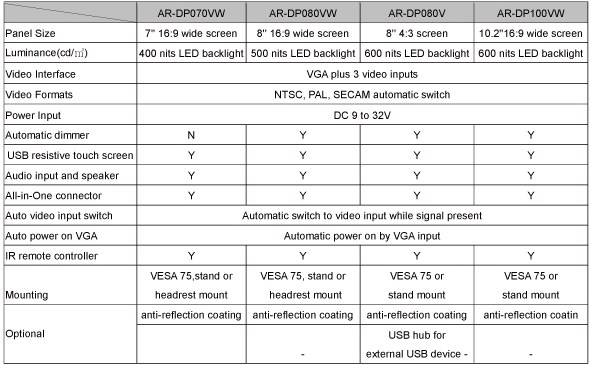
Whether it is for fleet management, taxi dispatch and infotainment, or police car, they all share common requirements: sunlight readable touch, wide operating temperatures, wide voltage. Acrosser’ s Vehicle grade LCD touch Monitor products feature Automatic screen brightness adjustment feature, Industrial grade high brightness, daylight readable LED backlit, DC9 to 32V power input and wide operating temperatures to accommodate these special environmental needs.


Industrial computer ,Panel PC ,single board computer

Industrial computer ,Panel PC ,single board computer

Posted in Industrial computer, Panel PC, single board computer | Tagged , , | Leave a comment

3.5 inch Single board computer supports Intel Atom E640 Chipset

 AR-B6051, which carries the Intel Atom E640 and E620. acrosser takes advantage of Atom E6xx series in design, such as low power consumption and small footprint. AR-B6051 supports DDR2 memory and capacity is 1GB. It’s the onboard design and it will avoid the risk of vibration and shock issue. Based on embedded concept, AR-B6051 has variety IO like 4 x serial port, 4 x USB, 2 x GbE and Mini-PCIe expansion. It offers the CF socket that embedded customers used to use, 1x SATA interface for the customers have large storage capacity request.

There is a Mini-PCIe expansion slot for customer’s expansion. As people know there is rapidly increasing request in wireless request, so Acrosser provides customer the option and customer can use the module directly without other carrier board to fix it. AR-B6051 also supports the can bus function that is widely used in the industrial applications.


Industrial computer ,Panel PC ,single board computer

Industrial computer ,Panel PC ,single board computer

Posted in Industrial computer, Panel PC, single board computer | Tagged , , | Leave a comment