Affect your salary some new and interesting data

When we asked respondents if their company has a hard time finding/hiring automation professionals, nearly 60% said “yes.” The job function that is hardest to fill, as identified by 61.9% of the respondents, is automation/control engineering. A distant second was instrumentation engineering (28.2%), followed by process engineering (17.1%).

There is nothing new here. We are in the middle of a skills shortage. By many estimates, we failed to train an entire generation of technical professionals. As the bar chart indicates, more than half (51%) of those surveyed said they will be retiring in the next 15 years.

Is there a silver lining? Many companies end up hiring retirees back to work as consultants, simply because they cannot find other employees with the necessary skills. It appears that the number of retirees who are willing to work after retirement is holding at 45.8% (exactly the same as last year). These respondents said they will retire in the next 10 years, but indicated they will continue to work part-time or offer consulting solutions after retirement.

We asked our survey respondents to give us an idea of how the economy is affecting certain factors within their companies.Economic effects

For the majority of respondents (more than 60%), most of the factors like salary, bonuses, overtime, layoffs, and promotions remain unchanged. However, here are three positive signs within some companies:

35.4% indicated that hiring of new employees has increased.
32.2% indicate that salaries have increased.
24.8% indicate that overtime has increased.

Conclusion

If you made it to this part of the article, congratulations! As a reward, I would like to present you with the following recipe of how to achieve the highest salary:*

Get your B.S. degree (any type of engineering will do). An advanced degree will improve results.
Select an energy-related industry segment.
Select a large company, preferably one with 10,000 or more employees, and stay there for your entire career.
Get your professional engineering (P.E.) license.
Move into a management position where employees report to you.
Work more than 50 hours per week.
Blend in one spouse.
Add one or two children (optional).
Become a member of a prominent industry organization.
Allow ingredients to intermingle during your career.
*Editor’s note: results may vary depending on elevation.

refer to:http://www.automation.com/factors-that-affect-your-salary-what-you-need-to-know

Posted in Uncategorized | Tagged , , , , | Leave a comment

Data At Remote Sites

For the most part, remote sites with critical equipment are located in places that are difficult to access due to long distances or harsh conditions. Accessing critical information, such as equipment health and operational data at these sites can be time-consuming and costly. Also, given today’s aging industrial infrastructures, monitoring and controlling the data within these sites is more critical than ever. In fact, we are beginning to witness the consequences of not updating and maintaining outdated networks, as demonstrated by recent explosions at gas pipelines and blackouts in major cities when parts of the electrical grids have gone down.

Keeping a closer eye on these infrastructures is necessary not only to prevent loss of revenue, but more importantly, loss of life. Unfortunately, however, communicating with remote sites to proactively prevent equipment degradation is far from an easy task and may even require a four-hour helicopter ride. In order to proactively monitor and control remotely located assets, users must be able to access local sensor data. The most cost-effective and intelligent way to do this is through cellular automation.

Using Cellular Automation
Cellular automation is the concept of providing remote terminal units (RTU) with cellular connectivity to access data in hard-to-reach locations. Cellular connectivity provides fast and easy access to monitor and control business-critical applications at remote sites. This flexibility, however, also requires a level of responsibility that requires enhanced security requirements as well. In some cases, this is new ground for many users, as data security is something that many customers did not focus on in the past since they were using direct circuit connections via modem banks.

These types of connections did not require the same stringent security standards that a cellular connection over an IP network does. Therefore, as customers migrate toward IP networking and data security is mandated, sourcing and implementing new technologies to support the increasing security demands becomes necessary.

In addition to addressing more stringent security requirements, industrial users face the complexity of having multiple devices to manage and implement for an effective remote monitoring and control solution over IP. The challenge facing many customers is that, on top of their existing RTUs, they must also figure out which of many products they will require. It may be necessary to have a device for cellular connectivity, a Modbus gateway and a security (VPN) device, which is costly to deploy and complicated to administer and maintain.

refer to:http://pipelineandgasjournal.com/using-cellular-automation-monitor-and-control-assets

Posted in Uncategorized | Tagged , , , , | Leave a comment

Machine Vision Color

Today, printed circuit boards require more color vision solutions because the color of a component helps to identify each part. Plugs and connectors are color coded, and at the same time, the board is tracked using a black-and-white barcode. “These applications used to be done with a high-resolution monochrome camera, but now, you need to be able to sense color to make sure the right component and connector are in the right place,” Kinney explains. “The barcode will usually be located at the edge of the frame. If you use a single-chip color camera, you have to be concerned about color shading and halos at the edge of the image, and it’s made worse if you use cheap optics.”
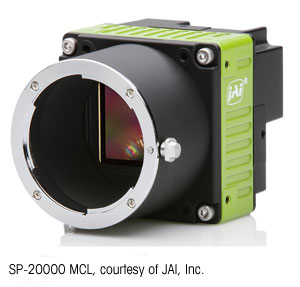
Color aberrations come in two flavors: axial, where the different wavelengths of light cause each color to focus on a different focal plane or distance from the optic, as well as transverse or longitudinal distortion, where a magnification causes different colors to focus on different points on the same focal plane even when they originate from the same point in front of the camera. Both effects can reduce contrast or produce halo effects in the image. While an electronics manufacturer will likely want the fastest possible frame rate and therefore ask for a high-resolution, high-frame-rate single-color camera solution such as JAI’s SP-20000 with 20 megapixel (MP) CMOSIS full-frame sensor (43.3 mm diagonal), the designer needs to be aware of potential lateral distortion and correct the problem through optical or software methods.

For colorimetric applications that require absolute color measurements (what is the exact red value) versus relative color measurements (which of these reds is the most saturated), three CCD chips offer better color accuracy. Precision dichroic coatings with sharp responses separate colored light better than color dyes used in single-chip Bayer filter solutions, allowing less color crosstalk between pixels. The use of low F-number prisms maximizes light throughput and maintains the color information with high spatial accuracy needed to give good results at the pixel level. However, three-CCD-chip cameras have their own design challenges, too.

refer to:http://www.visiononline.org/vision-resources-details.cfm/vision-resources/Is-Your-Machine-Vision-System-Color-Blind/content_id/4333

Posted in Uncategorized | Tagged , , , , | Leave a comment

BUSINESS OPERATIONS AND OPTIMIZATION

A Long Journey – But One Worth Embarking On

Knowledge and understanding empower workers, enabling operating companies to respond better to dynamic environments and work processes to be more flexible—facilitating a higher level of engagement. Networking Appliance collaboration, optimization and operations technologies can help industrial organizations manage critical assets, regardless of their physical location.

But this type of initiative is about more than just optimized operations; it’s truly about optimizing the business, which brings us back to the concept of not viewing this as a control room-board room issue – it’s an enterprise issue.

Yes, this Solutions can help operating companies securely access all their data, deliver information when and where it’s needed, create and monitor enterprise key performance indicators for decision support, and enforce consistent operational and business processes. But it also streamlines the overall business through benefits such as operational expense mitigation, consolidation and leverage of scarce expert resources, staff turnover mitigation and improved safety.

In the end, companies are able to act and react faster to market conditions, increase productivity and reliability, ensure regulatory compliance, and improve the safety of their employees with less downtime and more production availability.

It seems like a lofty goal – but it’s certainly more attainable today than it once was.

refer to:
http://www.automation.com/business-transformation-through-remote-collaboration-optimization-and-operations

Posted in Uncategorized | Tagged , , , , | Leave a comment

From kindergarten to Kickstarter

Resurgence of the Do It Yourself (DIY) community has driven a range of open hardware platforms, giving aspiring technologists cheap and easy access to embedded development. Outside of hobbyist toys and educational devices, however, “hacker” boards are increasing performance and I/O flexibility, and have become viable options for professional product development.

The “maker” movements of the past few years quickly gained traction in the education and hobbyist markets, as organizations began producing open hardware boards with a “less-is-more” architecture at a price to match. DIY boards like the Arduino, BeagleBoard, and Raspberry Pi provide “known state” programming platforms that allow easy exploring for novice developers, and enough flexibility for advanced hackers to create some pretty remarkable things – which they have.

Now, Kickstarter (www.kickstarter.com) projects like Ninja Blocks are shipping Internet of Things (IoT) devices based on the BeagleBone (see this article’s lead-in photo), and startup GEEKROO is developing a Mini-ITX carrier board that will turn the Raspberry Pi into the equivalent of a PC. Outside of the low barrier to market entry presented by these low-cost development platforms, maker boards are being implemented in commercial products because their wide I/O expansion capabilities make them applicable for virtually any application, from robotics and industrial control to automotive and home automation systems. As organizations keep enhancing these board architectures, and more hardware vendors enter the DIY market, the viability of maker platforms for professional product development will continue to increase.

“About five years ago when we launched the original BeagleBoard, what you could do with ARM devices was not as clear,” says Jason Kridner, Cofounder, BeagleBoard.org. “Especially as the superscalar ARM core was just coming out, people did not know much about what it was really capable of doing. The closest things out there were things like the Nokia N800-types of devices, but we were really taking a big jump in performance.

“For the most part, the approach was to put this cool technology into people’s hands and get out of the way,” Kridner continues. “It was really just to try to reach that price point so that folks that wanted to go and play with open source software on these platforms could go and do that. And it was really an industry changer; you can see all the things that have come since then.”

ARM boards ‘make’ their mark

From the beginning, maker board architectures stressed lowest-cost, low-power hardware, with an emphasis on multimedia and graphics. This led the Raspberry Pi Foundation and BeagleBoard.org to adopt ARM architectures for the processing element in their boards, resulting in similar architectures with comparable performance that catered to educational and hobbyist developers. Since then, variants have evolved to increase pin access and optimize performance for a range of development applications.

“All of the DIY ARM boards have broadly the same architecture – a System-on-Chip (SoC), which contains the processing, multimedia, and I/O in a shared-memory configuration, and one or two external chips to provide functionality that is missing from the core SoC,” says Eben Upton, Executive Director, Raspberry Pi Foundation. “There are a number of boards based on a couple of different SoCs that use Cortex-A8 cores at around 1 GHz; these can get ahead of the Raspberry Pi a little on integer and memory workloads, but lag behind on floating-point performance and multimedia, as A8s have a very weak Floating-Point Unit (FPU).”

“Going from the BeagleBoard to the BeagleBoard-xM, we added some extra memory, performance, and expansion capability,” Kridner says. “But with the BeagleBone, we kind of reset things and tried to say, ‘Let’s get down to the bare bones of what is really needed and desired.’ This was both in terms of more bones access – low-level expansion, A/D conversion, getting a lot more focused on that low-level I/O capability – and less of a focus on being a multimedia engine; the BeagleBone Black just took that progression further.

“For all the people building robots and drones and wanting to do hardware hacking, BeagleBone Black has all that expansion hardware on there (Figure 2),” Kridner adds. “For some of these platforms, if you wanted to do anything real-time, like precision timing for motor control, you would have to go out and buy an Arduino or some other sort of microcontroller system. Here, there are two 32-bit 200 MHz microcontrollers that have direct access to the pins. They are real-time and can let Linux[] do some of the things that it is great at like networking, high-level language support, GUI development, and the big number crunching, and let the low-latency stuff live on those 200 MHz microcontrollers. You come to it with whatever development baggage you already have; if you want to go into real engineering design and make an end product out of it, there is no barrier to doing that.”

x86 for professional-grade performance

As the DIY market continues filling out with developers of varying skill levels and intentions, the need for different classes of development boards has also emerged. Recently, x86-based maker boards have been released, offering increased compute power and high-speed I/O interfaces. Though slightly more expensive than their ARM-based predecessors, they target more serious development and are capable of scaling into traditional embedded applications.

“The Raspberry Pi and Beagle family have done a lot to bring new people into the world of embedded development, and that is a wonderful thing,” says Scott Garman, Technical Evangelist, Intel Open Source Technology Center. “As the embedded community grows and people seek out new projects to pursue, they are inevitably going to run into limitations on one platform or another. Just about every embedded board in the marketplace has something unique to offer, and the MinnowBoard will be a compelling choice for many applications, particularly those that require high I/O throughput.”

MinnowBoard is an Intel Atom-based platform equipped with interfaces like SATA, Gigabit Ethernet, and PCI Express, and is suited for applications such as Network Attached Storage (NAS) and Network security, Garman says (Figure 3). “Professional embedded developers working on commercial products will like the fact that the MinnowBoard is open hardware, and can be customized without having to sign any Non-Disclosure Agreements (NDAs),” he adds.

GizmoSphere has also entered the maker market with x86 process technology, including an AMD Embedded G-Series APU capable of 52.8 GFLOPS at under 10 W on their Gizmo board. Part of the Gizmo Explorer Kit, the package “was designed to be flexible so that designers can customize the system according to their specific development goals,” says Kerry Brown, Vice President and Chief Operations Officer, Sage Electronic Engineering.

“Gizmo was created to provide a flexible, multipurpose development board to serve the unique needs of embedded developers,” Brown says. “There [is] a wide range of interfaces on the Gizmo board, including PCIe, I2C, USB, and GPIO … to enable each developer’s unique design goals (Figure 4). The companion Explorer board provides a sea of holes for prototyping and debugging. The kit can be used by hobbyist developers who want to tinker at home on the weekends, or by entrepreneurs and small businesses developing their next product.”

From kindergarten to Kickstarter

Millions of maker boards have shipped to date, mostly as an extension of a thriving young DIY community. However, as open hardware platforms continue to surface as alternatives for commercial product development, it is possible that a generation of embedded engineers is being brought up by maker.

“I describe the target of the Beagle as kindergarten to Kickstarter,” Kridner says. “The next billion-dollar idea may not be from someone whose primary job function is writing firmware and Linux drivers and is an electrical engineer or computer science major, but they may be inspired by what they can do with technology. And we want to give them the tools to go out and avoid any barriers – to take their idea, rapidly prototype it, go to Kickstarter, and make their first million.”

refer to:
http://embedded-computing.com/articles/diy-pushes-open-hardware-kindergarten-kickstarter/



Posted in Uncategorized | Tagged , , , , | Leave a comment

IT Technology for industrial controls

It is the author’s opinion that integration of the controls network and the IT network is inevitable. It became inevitable the moment the controls industry chose to use Ethernet as the medium with which to communicate data. The controls industry may choose to be dragged kicking and screaming into the modern automation era, or it can gracefully embrace the change. Embracing means the controls industry would be able to leverage the myriad rich, existing technologies that have been proven foolproof in the IT world. To be dragged kicking and screaming into the modern communications era would do a terrible injustice to those who have worked diligently to bring it about. This could quite possibly add an entirely new facet to the fieldbus wars, which I hope have not been forgotten.

With that said, the controls world is going to be moving with an industry that has a definite consumer bias, with product development and release cycles of six months or less. In an industry where the average life expectancy of an automotive production line is eight years, it is impossible to expect the networking in an industrial setting to keep up with modern IT standards. Therefore, we turn our attention to the technologies that have existed the industrial, with the most open standards and the very best support. These are the protocols we wish to use and keep, and this article highlights and explains some of these technologies.

This article does not focus on the technical implementations of each piece of technology. Rather, it is assumed the reader will be using packaged solutions such as a function block for a PLC. These packages typically require only that the user specifies the relevant server to connect to, the data to be gathered and an activation bit. The particulars of each protocol and concept are, ideally, transparent to the user, and therefore it is not pressing that the user understands what is contained in each packet passed between the server and the client. As each protocol described in this article is openly documented and supported, a simple search on the Internet for the technical details will likely yield the relevant implementation details.

refer to:
http://www.automation.com/leveraging-it-technology-for-industrial-controls-applications

Posted in Uncategorized | Tagged , , , , | Leave a comment

Creating customized SDK

Creating a customized SDK basically comes down to selecting the set of embedded computer libraries and APIs that application developers should use, and then ensuring that they are built into the application development toolchain in a version-controlled way. If the application will take advantage of dynamic linking, then this also means ensuring consistent versions are built for the developers’ desktops as well as into the runtime target images. Delivering the SDK in an easily installable format solutions to ensure consistency across all application developers.

refer to: http://embedded-computing.com/articles/the-not-code-quality/

Posted in Embedded Computer, embedded pc | Tagged , | Leave a comment

Car market monitoring report

With the first car makers committing to the MOST150 network in selected vehicles from 2011 on, the suppliers of MOST devices, tools, and software solutions are focusing on optimizing their MOST150 product portfolio to ease the implementation in future car models. Key targets are cost efficiency and low power consumption while meeting MOST compliance requirements. MOST In-Vehicle computers solutions and tools are already available to enable successful infotainment implementations at the OEM and supplier level. The In-Vehicle computers  built-in signal routing and enhanced power management features are important building blocks for successful MOST system design words. Further Information on MOST: MOST Forum 2010. The MOST Forum 2010 promises a very high quality conference program offering an insight into the latest and future MOST Technology solutions and studies. This second international MOST Conference and exhibition will take place on 23 March 2010 in Frankfurt (Germany).

More information is available at www.mostforum.com

refer to: http://embedded-computing.com/news/most150-series-adoption/

Posted in Mini-ITX, Uncategorized | Tagged , , | Leave a comment

Graphics control speed for applications

OEMs also face the challenge of implementing this state-of-the-art technology in their new or existing applications, including validation and verification of the applications’ functionality and access to hardware functions and I/Os. To reduce the amount of R&D work, lower costs and shorten their products’ time to market, they seek ways to cut down their initial development and migration tasks. By the graphics core will speed up vector processing applications such as situational awareness, military and medical markets. One approach is to make use of a hardware vendor’ migration services. These embedded products as they are known, are no longer limited to the consumer market. They are making their entrance into the embedded market with the arrival of the new AMD Embedded G-Series platform. OEMs can now add the parallel processing power of the AMD Radeon 6310 GPU to their applications. By doing this, it’s possible to add supercomputer-like performance to small-form-factor embedded designs and obtain a previously unachievable performance-per-watt ratio. Additionally, with the support for OpenCL 1.1 and Microsoft DirectCompute, parallel embedded products .

refer to: http://embedded-computing.com/white-papers/white-small-form-factor-sff-designs-2/

Posted in 3.5 Biscuit SBC, 3.5 SBC, embedded pc | Tagged , | Leave a comment

Revealing the 4th generation Intel® Core™ processors

Kontron will implement on a broad range of embedded computing platforms. Based on the 22 nm Intel® 3D processor technology already used in the embedded computing, predecessor generation, the processors, formerly codenamed ‘Haswell’, have experienced a performance increase which will doubtlessly benefit applications.

This whitepaper gives engineers a closer look into the architectural improvements of the new microarchitecture and delivers the answers as to how they can integrate these most efficiently into their appliances.The 4th generation Intel® Core™ processors serve the embedded computing space with a new microarchitecture.

refer to: http://embedded-computing.com/white-papers/white-intelr-coretm-processors/

Posted in Embedded Computer, embedded pc, Panel PC | Tagged , , | Leave a comment